

How to get out of credit card debt fast minimum payments
When minimum payments feel impossible, the problem is not that you lack discipline — it is that minimum payments are mathematically designed to keep you in debt as long as possible while maximising the interest you pay. The fastest path out starts with four steps: stop adding new charges to the cards, call your card issuers and ask specifically about hardship programs to reduce your interest rate, choose either the avalanche method (highest APR first) or snowball method (smallest balance first), and find even $50–$100 extra per month to direct at your target card. If your debt exceeds 40% of your annual income and minimum payments are genuinely all you can afford, a nonprofit debt management plan or balance transfer may be more realistic than self-payoff alone.
The Minimum Payment Trap: Why It Feels Impossible — Because Mathematically, It Almost Is {#minimum-payment-trap}

There is a reason making minimum credit card payments feels like running on a treadmill. That is exactly what it is.
The average American credit card balance is $6,618. The average minimum payment is approximately 2% of that balance — $132 per month. At the average APR of 22%, here is what happens when you make only that minimum payment:
- Time to pay off: More than 7 years
- Total interest paid: Approximately $3,610
- Total cost of $6,618 in debt: Over $10,228
You borrowed $6,618. You pay back over $10,000. It takes seven years. And that assumes you never add another purchase to the card.
For someone carrying $15,000 — the average credit card debt per borrower — minimum payments become even more crushing. A $15,000 balance at 22% APR with minimum payments would take approximately 15–18 years to eliminate and cost more than $12,000 in interest alone — more than the original debt itself.
This is not a personal failure. It is arithmetic. Minimum payments on high-APR credit cards are engineered so that the interest charge each month consumes most of the payment, leaving almost nothing to reduce the principal. At 22% APR, a $6,618 balance generates $121 in interest in the first month. If your minimum payment is $132, you reduce the principal by $11. Eleven dollars. On a $6,618 debt.
More than 27 million Americans can only afford the minimum payment each month — meaning they are effectively paying almost entirely in interest while making near-zero progress on their principal.
This guide is written specifically for the 27 million people in that situation — not the people who can easily pay extra, but the people for whom even the minimum payment is a strain. There are strategies here for every situation, including the ones where self-payoff alone is not realistic.
The 2026 Credit Card Debt Crisis: You Are in the Majority

Americans’ total credit card balance is $1.277 trillion as of the fourth quarter of 2025 — the highest balance since the New York Fed began tracking this data in 1999. Credit card balances have risen by $507 billion since Q1 2021, when credit card debt bottomed out at $770 billion during the pandemic.
That $507 billion increase in four years reflects something specific: inflation that outpaced wages, emergency expenses that had nowhere else to go, and a pandemic-era savings cushion that has now been fully depleted for most households.
41% of credit card debtors cite an emergency expense as the primary cause of their debt — medical bills, car repairs, home repairs. Another 33% point to day-to-day expenses like groceries and utilities. Only 10% cite discretionary retail purchases. Most people did not go on shopping sprees. They were trying to get through a rough stretch and credit was the only bridge available.
47% of American credit cardholders carry a balance as of late 2025. 49% of Americans now describe credit card debt as “normal.” 19% of credit card debtors worry they will not be able to make their minimum payments in the next six months.
Adults aged 18–29 are transitioning into 90-day credit card delinquency at roughly three times the rate of borrowers aged 60–69. Bankrate’s 2026 survey found that 53% of both Gen Xers and Millennials carry a credit card balance month to month.
These numbers are not shared to normalise the debt — they are shared to remove the shame that prevents people from taking action. Credit card debt in 2026 is an almost universal American financial experience. The people who successfully get out of it do not do so because they are exceptional. They do so because they followed a specific sequence of steps that this guide gives you in full.
Step 1 — Stop the Bleeding: No New Charges Before You Start

Before any payoff strategy can work, one thing has to change: the cards stop being used for new purchases.
This sounds obvious. It is also the step most people skip or negotiate with themselves about. “I’ll use the card for gas and pay it off each month.” “Just this one purchase.” “I need the rewards points.”
Here is the problem. When you are making minimum payments and trying to pay extra, every new purchase adds to a balance that is already generating daily interest. If your card charges 22% APR and you add $200 in new purchases while trying to pay down an existing balance, those $200 start generating $3.78 in interest per month immediately. The extra $50 you redirected from your budget toward payoff is absorbed before it touches the principal.
The first non-negotiable step is to stop adding new charges to any card you are trying to pay off. Not reduce new charges. Stop them.
If you need to continue using a card for essential expenses like groceries or gas — because your budget requires it — designate one card for that purpose, keep the charges to the absolute minimum, and pay those new charges in full each month while directing your payoff effort at the other cards.
Practical mechanics:
- Remove saved card information from all online shopping accounts
- Delete shopping apps that have the card on file
- Physically put the cards you are paying off in a drawer — not your wallet
- If you cannot trust yourself with the cards, freeze them in a block of ice, cut them, or ask a trusted person to hold them
The goal for the first 30 days of any debt payoff plan is zero new charges on the cards you are attacking. Everything else builds on that foundation.
Step 2 — The Hardship Program Call: The Option Nobody Uses But Almost Everyone Qualifies For
This section is the most underused strategy in credit card debt payoff — and potentially the most impactful for people who genuinely cannot afford more than minimum payments.
Every major credit card issuer — Chase, Citi, Bank of America, Discover, Capital One, American Express — has a formal hardship program. These programs can temporarily:
- Reduce your interest rate by 5–15 percentage points
- Reduce your minimum payment
- Waive late fees
- Pause payments for 1–3 months in severe hardship situations
These programs exist because issuers would rather work with you and recover the money over time than have you default, which they recover nothing from. They are not widely advertised because issuers profit more when you pay the full APR.
How to access a hardship program:
Call the number on the back of your card. When the automated system answers, say “financial hardship” or “hardship program” — this often routes you to a specialized team. If not, ask the first representative to transfer you to the “account services” or “hardship assistance” team.
When you reach a representative, say specifically: “I am having difficulty making my payments due to [job loss / medical expenses / reduced income / cost of living increases], and I would like to know what hardship programs are available for my account.”
You do not need to provide extensive documentation on the first call. You do need to be honest about your situation.
What to ask for explicitly:
- A temporary interest rate reduction
- A reduced minimum payment for 6–12 months
- Waiver of any recent late fees
- Any available payment deferral
Realistic outcomes: A card at 24% APR reduced to 9–12% during a hardship program changes the math dramatically. On a $6,000 balance, the monthly interest at 24% is $120. At 10%, it is $50. That $70 difference per month — applied to principal — accelerates payoff by years.
Hardship programs are typically available for 6–12 months. After the program ends, your rate returns to the original level. But those months of lower interest can make meaningful principal reduction possible that was not happening before.
Keep records of every call: date, time, representative name, and what was agreed to in writing. Ask for written confirmation of any changes to your account terms.
For understanding how credit cards affect your broader financial life: How Credit Cards Affect Your Personal Finances →
Step 3 — Choose Your Payoff Strategy: Avalanche vs Snowball
Once new charges are stopped and you have explored hardship programs, the core payoff strategy begins. There are two evidence-backed methods, and the one you choose should depend on your specific situation — not on which sounds more mathematically pure.
The Avalanche Method: Maximum Interest Savings
The avalanche method directs every extra dollar above minimum payments toward the card with the highest interest rate first, while maintaining minimum payments on all other cards.
Why it works: You are eliminating the most expensive debt first. Once the highest-rate card is paid off, the money that was going to it rolls down to the next highest-rate card.
Example:
- Card A: $3,000 balance, 24% APR
- Card B: $5,000 balance, 19% APR
- Card C: $1,500 balance, 15% APR
Avalanche order: Card A → Card B → Card C
Total interest saved compared to minimum-only payments: Typically 20–35% less total interest paid over the payoff period.
Best for: People who are motivated by math and can maintain discipline through a longer initial period before seeing a card fully paid off.
The Snowball Method: Psychological Momentum
The snowball method directs every extra dollar toward the card with the smallest balance first, regardless of interest rate, while maintaining minimum payments on all other cards.
Why it works: Paying off a complete balance — even a small one — provides a genuine psychological win. That completion triggers motivation that sustains the effort through longer-term payoff of larger cards.
Example using same cards:
- Card C: $1,500 balance → pay off first (regardless of lower rate)
- Card A: $3,000 balance → pay off second
- Card B: $5,000 balance → pay off last
Research support: A study published in the Journal of Consumer Research found that people who used the snowball method were more likely to eliminate all their debt than those using the avalanche, specifically because the psychological wins sustained behavior over time.
Total interest paid: Slightly more than the avalanche method — but if the alternative is abandoning the avalanche after three months and paying nothing extra, the snowball wins in the real world.
Best for: People who have tried and failed to maintain debt payoff plans before, or who need concrete evidence of progress to stay motivated.
Which One Should You Choose?
If your highest-rate card also has your smallest balance — use the avalanche. You get mathematical efficiency and a quick win simultaneously.
If your highest-rate card has a large balance that will take 18+ months to eliminate — seriously consider the snowball. The psychological reality of making payments for a year and a half without a single payoff milestone is difficult to sustain.
The best debt payoff method is the one you will actually complete. Both the debt avalanche method and debt snowball method are effective strategies for paying off credit card balances.
Step 4 — Find Your Extra Money: The Budget Surgery Method
The payoff methods above require one thing: extra money above the minimum payment. For someone whose minimum payments are already a strain, finding even $50–$100 per month can feel impossible.
The budget surgery method is not about willpower or sacrifice. It is about a systematic, time-limited audit of every dollar going out — with the specific goal of finding a defined amount to redirect to debt payoff.
The 90-day emergency budget:
For 90 days — not forever, 90 days — implement an extreme temporary budget with one goal: generate the maximum possible extra payment toward your highest-priority debt. After 90 days, assess what you can maintain permanently.
The four surgery categories:
Category 1 — Eliminate immediately (zero discussion): Every subscription or recurring charge you cannot immediately articulate the value of. Every streaming service beyond one. Every app subscription, gym membership you use less than twice a week, premium service you could replace with a free version. The average American pays $219/month in subscriptions with 80% unaware of their total. A 30-minute audit of your bank statement will find $60–$150/month in this category for most households.
Category 2 — Temporary suspension (90 days): Dining out beyond one meal per week. Clothing purchases (there is nothing in your closet that cannot get you through 90 days). Entertainment spending above a fixed low ceiling. These return after the 90 days if finances allow — but the temporary pause redirects cash to debt.
Category 3 — Negotiate lower (one call each): Internet provider — call and ask for the promotional rate or a lower tier. Insurance — get one competing quote and use it as negotiating leverage. Phone plan — most carriers have lower-cost options they do not advertise.
Category 4 — Generate one-time cash: Sell everything of value you do not use — electronics, furniture, clothing, sporting equipment. Sell on Facebook Marketplace, eBay, or a local consignment shop. Any one-time cash generated goes directly to the target debt’s principal — not to the minimum payment, to an extra lump-sum payment that reduces the balance immediately.
The realistic target: Most households can find $80–$200/month through this audit. At $100 extra per month applied to a $3,000 balance at 22% APR, the payoff timeline drops from 40+ months (minimum payment only) to approximately 18 months. The interest savings are approximately $1,200.
Step 5 — Balance Transfers: When a 0% Card Can Save Thousands
A balance transfer moves existing high-interest credit card debt to a new card with a 0% introductory APR — effectively stopping the interest clock for a defined period, typically 12–21 months.
During that promotional period, every dollar you pay goes entirely to principal. No interest. This can dramatically accelerate payoff on a fixed budget.
Example: $5,000 balance at 22% APR. You can afford $250/month.
Without balance transfer:
- Time to payoff: approximately 26 months
- Total interest paid: approximately $1,450
With a 15-month 0% balance transfer (assuming 3% transfer fee):
- Transfer fee: $150
- Monthly payment of $250 for 15 months pays off the full balance within the promotional period
- Total cost: $150 (transfer fee only)
- Interest saved: approximately $1,300
The conditions for a balance transfer to make sense:
- You can qualify. Balance transfer cards typically require a credit score of 660 or higher. If your score has been damaged by late payments, you may not qualify for the best offers.
- You can pay off the balance within the promotional period. Divide your balance by the number of promotional months. If the result exceeds what you can realistically pay monthly, the balance transfer will not be fully effective.
- You stop using the old card. Balance transfers only work if you do not continue accumulating debt on the card you transferred from.
- You read the terms carefully. Balance transfer fees are typically 3–5%. The rate that applies after the promotional period ends can be very high — sometimes higher than your original card. Know the post-promotional rate before transferring.
Best balance transfer cards (research current offers as rates change frequently):
- Citi Diamond Preferred: consistently among the longest 0% periods
- Wells Fargo Reflect: competitive promotional duration
- Discover it Balance Transfer: 0% introductory period with no annual fee
For managing debt consolidation across multiple accounts: How Debt Consolidation Works and When It Helps →
Step 6 — Debt Consolidation Loan: When It Makes Sense and When It Does Not
A debt consolidation loan replaces multiple credit card balances with a single personal loan at a (hopefully) lower interest rate. Instead of managing four cards at 20–24% APR, you make one monthly payment on a personal loan at 10–14% APR.
When a consolidation loan makes sense:
- You can qualify for a personal loan at a rate meaningfully lower than your current card APRs
- You have a stable income that the loan underwriting can verify
- Your credit score is sufficient to access competitive rates (typically 650+)
- You have a concrete plan to not accumulate new credit card debt during the loan term — because if you charge the cards back up while paying the loan, you end up with both the loan and new card debt
When a consolidation loan does NOT make sense:
- The interest rate you qualify for is similar to or higher than your current card rates
- Your income is unstable or irregular (which affects underwriting and your ability to make fixed monthly payments)
- The loan term is so long that you end up paying more in total interest despite a lower rate
- You have not addressed the spending behavior that created the debt — consolidation without behavioral change often results in maxed-out cards again within 12 months
The critical calculation: Before taking any consolidation loan, calculate the total interest cost over the full loan term and compare it to the total interest cost of your current payoff plan at the current APRs. The consolidation should produce measurably less total cost — not just a lower monthly payment.
A lower monthly payment is not necessarily a better deal. Extending a 3-year payoff plan to 5 years at a slightly lower rate can cost more total interest while freeing up monthly cash flow. Know what you are trading.
Step 7 — Nonprofit Credit Counseling and Debt Management Plans
If your debt is large, your income is limited, and self-payoff strategies feel genuinely unrealistic, a nonprofit debt management plan (DMP) is the most structured and protective option before considering settlement or bankruptcy.
What is a nonprofit DMP?
The National Foundation for Credit Counseling (NFCC) and its member agencies connect consumers with certified credit counselors who negotiate reduced interest rates with credit card issuers — typically to 6–9% — on your behalf. You make one monthly payment to the agency, which distributes it to your creditors.
What a DMP typically looks like:
- Duration: 3–5 years
- Monthly fee: $25–$75/month
- Interest reduction: from 20–24% to 6–9% on enrolled cards
- Credit impact: accounts are typically closed during enrollment, which temporarily affects your score but improves as debt decreases
The mathematics of a DMP:
$10,000 in credit card debt at 22% APR:
- Minimum payment only: $10,000 balance takes 22+ years to eliminate, $14,000+ in interest
- DMP at 7% APR with $300/month payment: eliminated in approximately 38 months, $1,800 in interest
The DMP saves approximately $12,000+ in interest on $10,000 of debt over the payoff period.
How to find legitimate nonprofit counseling:
- NFCC member agencies: search at nfcc.org
- FCAA member agencies: search at fcaa.org
- All legitimate nonprofit counselors are free or low-cost ($25–$75/month maximum)
- Avoid for-profit “debt settlement” companies that charge percentage-of-debt fees and often damage your credit more severely than bankruptcy
The credential to look for: Certified Credit Counselor designation through the NFCC or AFCC. Do not pay significant upfront fees to any credit counseling service.
For understanding your credit score impact during debt payoff: How Credit Cards Affect Your Personal Finances →
The Last Resort Options: Settlement and Bankruptcy — What They Actually Mean
These options cause real financial damage and should be understood clearly before being considered. They are also legitimate paths for specific situations where other options are genuinely not viable.
Debt Settlement
Debt settlement means negotiating with creditors to accept a lump sum payment for less than the full balance owed. Settlement companies typically negotiate 40–60 cents on the dollar — meaning a $10,000 debt might settle for $4,000–$6,000.
The real costs of settlement:
- Credit damage: Settled accounts appear on your credit report as “settled for less than full amount” for seven years, which significantly lowers your score.
- Taxable income: The forgiven portion of the debt is generally treated as taxable income by the IRS. A $4,000 forgiveness on a $10,000 settlement creates a $4,000 taxable event — meaning a potential tax bill of $880–$1,100 at a 22–28% effective rate.
- Settlement company fees: For-profit settlement companies typically charge 15–25% of the enrolled debt amount. On $10,000 of debt, that is $1,500–$2,500 in fees.
- The test: If you cannot pay off your total credit card debt within 3 years using the avalanche or snowball method, and your total debt exceeds 40% of your annual income, self-repayment strategies alone are unlikely to get you out. That is the threshold where more comprehensive solutions — including settlement — may become realistic.
Bankruptcy
Chapter 7 bankruptcy eliminates most unsecured debt including credit cards within 3–6 months. Chapter 13 bankruptcy creates a 3–5 year structured repayment plan under court supervision.
Both forms remain on your credit report for 7–10 years. However, for people with debt genuinely beyond their ability to repay, bankruptcy provides a legal fresh start that settlement cannot.
The decision between settlement, bankruptcy, and a DMP requires consultation with a nonprofit credit counselor and, for bankruptcy specifically, a bankruptcy attorney. Most bankruptcy attorneys offer free initial consultations.
How to Rebuild After Paying Off Credit Card Debt
The moment your last card is paid off is one of the best financial moments most people experience. Here is what to do with the money and momentum.
Immediately redirect the monthly payment to savings: The $300/month you were paying toward credit card debt should go directly and automatically into a high-yield savings account the month after payoff. You have already proven you can live without that $300 — direct it to building the emergency fund that prevents credit card debt from returning.
Keep at least one card open — but use it with strict rules: Closing all your credit cards after payoff damages your credit score (available credit decreases, average account age may decrease). Keep your oldest card open. Put one recurring charge on it — a streaming subscription, a phone bill — and pay the full balance automatically each month. This maintains your credit history without risk of accumulating new debt.
Build your emergency fund to $1,000, then $5,000: The most common reason people return to credit card debt after payoff is an unexpected expense with no other payment option. An emergency fund makes the credit card unnecessary for emergencies. One month of freedom from a recurring $300 credit card payment deposited to savings gets you to $300. Six months gets you to $1,800.
Set a personal credit card rule going forward: The only rule that prevents credit card debt from returning is this: never carry a balance. If you cannot pay the full statement balance before the due date every single month, the card does not get used for that purchase. This is the permanent boundary that separates using credit cards as a financial tool from using them as a financing mechanism.
For the complete personal finance foundation that prevents debt from returning: Personal Finance for Beginners: The Complete 2026 Guide →
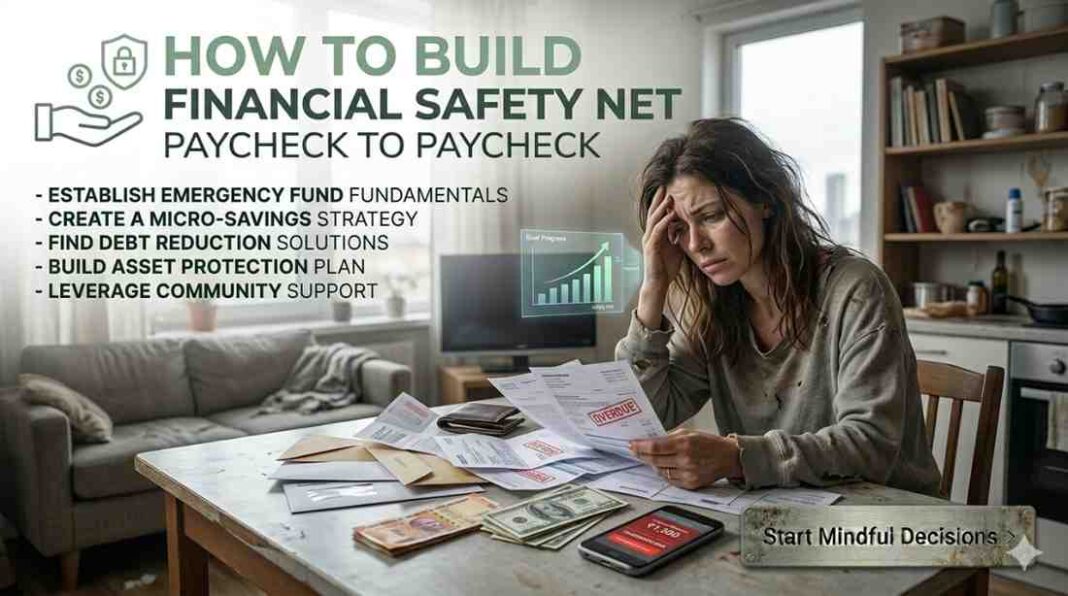
For building the savings safety net alongside debt payoff: How to Build a Financial Safety Net When You Live Paycheck to Paycheck →
FAQ: How to Get Out of Credit Card Debt Fast Minimum Payments
Optimised for Google People Also Ask and AI engine direct answers.
How long does it take to pay off credit card debt?
The average American credit card balance of $6,618 at 22% APR takes more than 7 years to eliminate with minimum payments only and costs approximately $3,610 in interest. With an extra $100/month above the minimum payment, the same balance is eliminated in approximately 3 years with approximately $1,400 in interest. The fastest path combines stopping new charges, calling for hardship rate reductions, and directing every available extra dollar to the highest-rate card first.
What are credit card hardship programs and how do I access them?
Credit card hardship programs are temporary arrangements offered by card issuers to customers experiencing financial difficulty. They can include temporary interest rate reductions (typically from 20–24% to 6–12%), reduced minimum payments, late fee waivers, and payment deferrals. To access them, call the number on the back of your card, say “financial hardship” or ask to speak to the hardship assistance team, and explain your situation honestly. These programs are not widely advertised but are available at virtually all major issuers including Chase, Citi, Bank of America, Discover, and American Express.
What is the fastest way to pay off credit card debt?
The fastest method mathematically is the avalanche — directing every extra dollar above minimum payments to the highest-APR card first. However, the practically fastest method is the one you will sustain for the full payoff period — which for many people is the snowball (smallest balance first), because paying off individual cards provides psychological wins that maintain motivation. Combining either method with a hardship rate reduction call and a 0% balance transfer on your largest balance can reduce the timeline significantly.
Should I use a balance transfer to pay off credit card debt?
A balance transfer makes sense when: you can qualify for a 0% introductory APR card (typically requires a 660+ credit score), your balance can be paid off within the promotional period, and you stop using the original card to avoid accumulating new debt. The balance transfer fee (typically 3–5%) is almost always less than the interest you would pay during the same period at your current APR. It does not make sense if you cannot pay off the balance before the promotional period ends, as the post-promotional rate can be very high.
What is a nonprofit debt management plan?
A nonprofit debt management plan (DMP) is a structured payoff program administered by a nonprofit credit counseling agency. The agency negotiates reduced interest rates with your creditors — typically to 6–9% — and you make one consolidated monthly payment to the agency, which distributes funds to your creditors. DMPs typically run 3–5 years, charge small monthly fees of $25–$75, and can save significant total interest compared to minimum payments at original rates. Find legitimate agencies through the NFCC (nfcc.org) or FCAA (fcaa.org).
Is it better to use the avalanche or snowball method for credit card debt?
The avalanche method (highest APR first) saves the most money in total interest. The snowball method (smallest balance first) is psychologically easier to sustain. Research published in the Journal of Consumer Research found that people using the snowball method were more likely to eliminate all their debt, because the quick wins maintained motivation. Choose the avalanche if you can remain disciplined without early wins. Choose the snowball if you have tried debt payoff plans before and abandoned them — the psychological wins are real and meaningful.
When should I consider debt settlement or bankruptcy?
Debt settlement and bankruptcy are appropriate when debt genuinely cannot be repaid within a realistic timeframe through normal payoff strategies. A practical threshold: if your total credit card debt exceeds 40% of your annual income and minimum payments represent more than 15% of your monthly take-home pay, consult a nonprofit credit counselor and potentially a bankruptcy attorney. Both settlement and bankruptcy cause significant credit damage but provide structured resolution that may be preferable to years of minimum payments with no progress.
How much extra should I pay on my credit card each month?
Every extra dollar above your minimum payment directly reduces interest accumulation. Even $25 extra per month accelerates payoff meaningfully. The most impactful amounts: $50/month extra on a $3,000 balance at 22% APR reduces payoff from 30+ months to approximately 20 months. $100/month extra reduces it to approximately 15 months. Calculate your specific scenarios using any credit card payoff calculator — the numbers are often more motivating than the abstract advice to “pay more than the minimum.”
The Bottom Line: The Minimum Payment Is the Problem, Not You
If making minimum payments on your credit cards feels hopeless, that feeling is arithmetically justified. Minimum payments on high-APR balances are not designed to help you become debt-free. They are designed to maximise the interest the issuer collects from you over the longest possible period.
The path out is not about finding more willpower. It is about following a specific sequence: stop new charges, call for a hardship rate reduction, choose a payoff method and start it this month, find any extra amount above the minimum to direct at the target card, and explore structural options — balance transfers, consolidation loans, or nonprofit DMPs — if self-payoff alone is not realistic given your debt-to-income situation.
None of this needs to last forever, but buckling down for a period of time and knocking out your credit card debt can do wonders for your overall financial situation.
The 27 million Americans making only minimum payments are not there by choice. Most of them are there because an emergency put them there — a medical bill, a job loss, a period of reduced income. The emergency is over for many of them, but the debt remains. The action to take is not to accept the debt as permanent. It is to pick the next step from this guide and take it today.
Your next step: Call the number on the back of your highest-APR credit card right now. Ask for the hardship team. Ask specifically about a temporary interest rate reduction. The call takes 15 minutes. The interest savings can be measured in thousands of dollars.
Explore More on Skilled Octopus
- How Credit Cards Affect Your Personal Finances →
- How Debt Consolidation Works and When It Helps →
- Personal Finance for Beginners: The Complete 2026 Guide →
- How to Build a Financial Safety Net When You Live Paycheck to Paycheck →
- Buy Now Pay Later Hidden Costs: What Nobody Tells You →
Follow us one Facebook & Instagram for more Educational Content
Last updated: May 2026. This article is for educational and informational purposes only and does not constitute financial or legal advice. Consult a certified credit counselor or financial advisor for guidance specific to your situation.